
Authors – Anil Kulkarni; Amit Bhargava, Mentors, SI Hub
Social entrepreneurship has always carried a special kind of ambition: not just to build a successful venture, but to create meaningful change in society. Unlike conventional entrepreneurs, social entrepreneurs are not driven by profit alone. Their mission often includes improving livelihoods, solving social problems, reducing inequality, or enabling underserved communities to thrive.
But this noble intent also creates a unique challenge.
A traditional entrepreneur typically focuses on one core question: Will the market accept this? A social entrepreneur, however, must answer two questions simultaneously: Will the market accept this, and will this truly improve the lives of the people I want to help? That dual responsibility makes social entrepreneurship inherently more complex — and, in many ways, demands that social entrepreneurs be “twice as smart.”
The Social Entrepreneur’s Double Challenge
There is an important distinction between traditional entrepreneurs and social entrepreneurs through the lens of value and risk. For conventional entrepreneurs, value is usually measured in financial terms — return on investment, profitability, margins, and cash flow. Those metrics are clear, well-established, and easy to compare.
For social entrepreneurs, value is far more difficult to define. Is the value in increasing income for the beneficiaries? Improving quality of life? Enabling education? Creating dignity? Supporting equality? All of these may matter — but they are multidimensional, often qualitative, and difficult to measure with one common yardstick. In short, while money is the destination for a conventional entrepreneur, for a social entrepreneur it is usually a means to a social impact end.
The same difference applies to risk. In traditional entrepreneurship, risk is largely market-based: Will the product sell? Will customers pay? Will the business survive? Tools like market research, financial modelling, and cash flow planning help reduce this uncertainty.
For social entrepreneurs, risk operates on two fronts:
- Market risk — the same risk every enterprise faces.
- Beneficiary risk — the risk of failing to improve the lives of the intended beneficiaries.
This second risk is often under-examined, even though it is central to the mission.
Why Good Intentions Are Not Enough
One of the critical things is to examine how many social enterprises — especially smaller, grassroots ones — actually get started. The social entrepreneurs, typically working in the tribal sector, work with what is locally available, using local skills and resources in creative ways, often at a small scale and with a deep personal commitment to improving a particular community.
These entrepreneurs are often highly passionate, but that passion can sometimes substitute for method. And this leads to a common problem: many social enterprises jump to a solution before fully understanding both the customer and the beneficiary.
A Better Way: Design Thinking for Both Ends of the Model
The proposed solution to the problem is adapting design thinking to social entrepreneurship in a way that gives equal importance to the customer and the beneficiary. Traditional design thinking has long been used as an iterative, human-centred approach to problem solving. Rather than moving in a rigid linear path, it encourages cycles of empathy, definition, ideation, prototyping, and refinement. This approach is especially useful for social entrepreneurs — but only if the process is expanded to reflect the reality that social enterprises serve two constituencies, not one.
The proposed model therefore runs two parallel processes:
- One for understanding the beneficiary
- One for understanding the customer
This is powerful because in social entrepreneurship, the beneficiary is not just a passive recipient of help. Very often, the beneficiary is central to the solution itself — as producer, participant, maker, or co-creator. Therefore, the enterprise succeeds only when both sides benefit. The suggested model which is adapted from the basic design thinking model which is well known and understood.
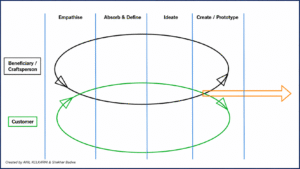
In this model there are two processes that are running in parallel. There is a process for the customer and there is a process for the beneficiary. The social entrepreneur now has a better chance of reducing risk at the beneficiary end as well as the customer end by travelling both paths, the customer’s and the beneficiary’s, and has the task of integrating both to come up with a solution that works.
The suggested process thus includes a path as below:
- Empathize with the beneficiary: Understand their world, aspirations, constraints, capabilities, and what would improve their lives.
- Define the beneficiary’s needs: Clarity on what is genuinely meaningful, feasible, and desirable from their perspective.
- Empathize with the customer / benefactor: Understand their environment, pain points, and unmet needs — without prematurely forcing a solution.
- Define the needs of the customer / benefactor: Identify what would create value for the customer and what problems are worth solving.
- Look for overlap and insight: This is the point where the two streams begin to connect and the solution makes commercial sense
- Ideate using both sets of data and generate solutions that work for both customer and beneficiary.
- Prototype and test the solution at both ends: Does it work for the customer? Does it work for the beneficiary?
This is not a one-time sequence. It is an iterative back-and-forth process, where the entrepreneur moves between customer understanding and beneficiary understanding until a stronger, lower-risk model emerges.
Practical Tools Social Entrepreneurs Can Use are
- Formalize exploration on the beneficiary side – Instead of entering a village or a region with one predetermined product idea, the entrepreneur should explore a wider set of livelihood possibilities with the community by building an opportunity matrix that compares different options and evaluates them systematically. This creates room for dialogue, trade-offs, and better decision-making.
- Use tools like the Value Proposition Canvas, especially as a way to deepen empathy and generate insights for both customers and beneficiaries. It can help clarify what each side values, what pains they experience, and what gains matter most.
Examples:
1: A social enterprise based in Uttarakhand was established to create an alternate source of livelihood for the families of villagers living in areas having vast expanse of pine forests. They offer an entire range of products which is handcrafted by the local women of Uttarakhand. Based on a beneficiary and customer study, the founders realized that for the organization to succeed, they needed to make it more lucrative for the artisans and hence their strategy has evolved from bulk Orders to premium pricing. By doing this, the beneficiaries’ interests were met based on their expectations of income that would help them in their lives. They also had to focus on community development and change the mindset of the artisans. At the customer’s end, process standardization and ensuring quality of production enabled them to attract more customers and also gain repeat customers. The products sought by the customers could be made by many rural women with necessary training resulting into maximizing the beneficiaries’ count.
- The social enterprise understood that the lower product prices were keeping artisans away.
- Market survey revealed that there was a large market in institutional sales. Large orders with fewer skus. This translated into simpler production techniques and lower inventories
- Further discussion with potential customers revealed that higher prices could be charged.
- All this was taken into account to arrive at a strategy that gave the artisans better incomes and generated repeat demand.
2: A social enterprise based in Maharashtra was selling honey to consumers. The honey was procured from tribals who knew how to extract honey without harming the bees. The income from the sale of honey was distributed to the tribals. A study of the customer expectation and competition revealed that there was an opportunity to increase price of the honey to consumers. This was followed by a packaging upgrade, and the net result was that the tribals got a larger income.
- The social enterprise went back to the beneficiaries – the tribals and understood their need. The current honey product was delivering a lower price. The tribals needed higher incomes that would take them through the non-productive season.
- A scan of the market revealed the competition. What were the prices, value proposition etc.
- All this was then taken into consideration to reposition the product with better packaging and higher price.
The Big Takeaway
Social enterprises fail not because the intent is weak, but often because the model is incomplete. When a social entrepreneur focuses only on helping the beneficiary but does not understand the market, the enterprise becomes financially fragile. When they focus only on the market but fail to deeply understand the beneficiary, the social mission weakens or collapses. The real work is to integrate both ends of the business model in a structured, thoughtful, iterative way.
That is why social entrepreneurs need to be twice as smart!! They must design not just for customers, but for communities. Not just for demand, but for dignity. Not just for market fit, but for social fit. And if they do that well, they don’t just build enterprises. They build impact that lasts!!